Why Architecture Firms Lose Profitability as They Grow
Why Architecture Firms Lose Profitability as They Grow
Why Growing Architecture Firms Experience Margin Drift
An Insight on Financial Governance from Daleyn Accountancy
Growth is often treated as the clearest indicator of success within architecture firms. An expanding client base, larger project scopes, increased headcount, and broader market visibility all suggest a firm that is progressing.
Yet growth, on its own, is not a reliable measure of profitability.
Many firms experience a less visible challenge as they scale: margin drift.
Revenue increases. Project volume expands. Organisational complexity grows.
However, profitability does not increase at the same pace. In some cases, it even declines.
This pattern is more common than many firm leaders realise. It reflects the way architecture businesses naturally evolve as they grow.
Understanding why profit margins compress during periods of expansion requires looking beyond revenue and examining how project delivery changes over time.
The Structural Nature of Growth in Architecture Firms
Architecture firms often grow by taking on more projects rather than redesigning the way the business operates.
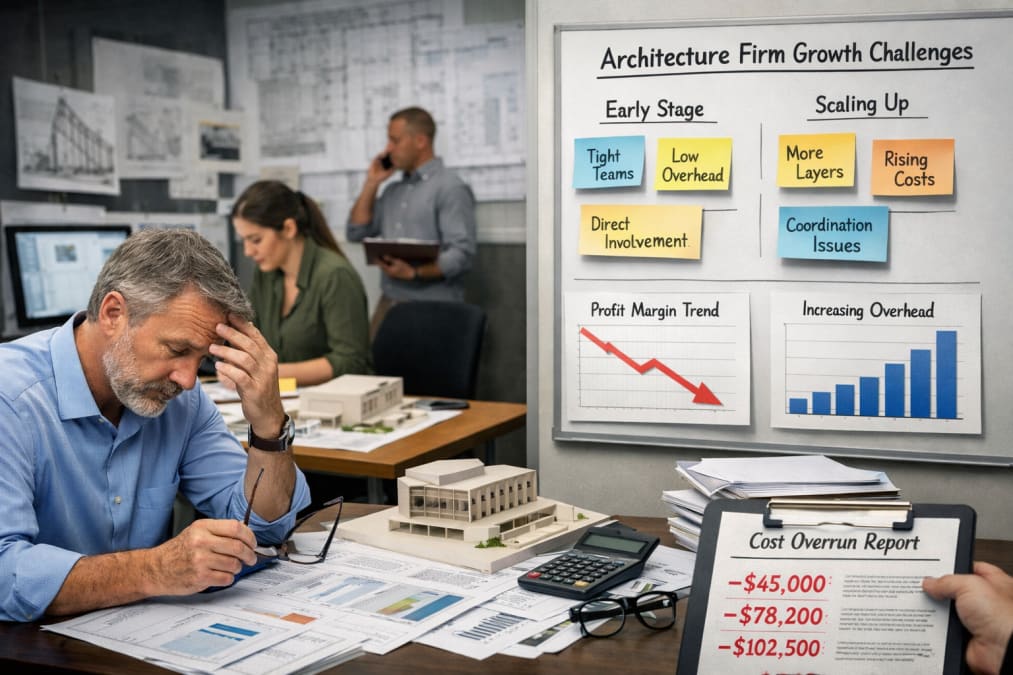
In the early stages, firms work with a high level of cohesion. Leadership remains closely involved in design, client communication, and project delivery. The connection between effort and results is direct and easy to understand.
At this stage, profitability often appears strong because:
- Senior leadership contributes directly to billable work.
- Communication is quick and informal.
- Project teams are small and highly coordinated.
- Overhead costs remain relatively low.
- Fee negotiations are supported by the personal reputation of the firm's leaders.
Together, these factors create an operating model where design, management, and delivery remain closely aligned.
As firms expand, however, this model becomes more difficult to maintain.
Hiring increases delivery capacity but also introduces additional coordination. Leadership gradually shifts from production to oversight. Project portfolios become larger and more varied.
Without corresponding improvements in financial management, these changes create structural inefficiencies.
These changes often appear gradually:
- Senior architects spend more time coordinating teams than producing billable work.
- Project timelines extend beyond initial assumptions.
- Internal processes become more complex.
- Delivery costs increase without being fully measured.
The business continues to function effectively, but it becomes less economically efficient over time.
Why Margin Drift Occurs
Margin drift rarely results from a single mistake. Instead, it develops through the interaction of several structural factors.
1. Fee Structures Do Not Keep Pace with Delivery Complexity
Many firms continue using pricing models developed when projects were delivered by smaller teams with simpler workflows.
As firms grow, project delivery changes. More internal reviews, consultant coordination, quality control, and stakeholder communication become necessary.
Although the project scope may remain similar, the resources required to deliver it increase.
In many cases, fee structures remain unchanged.
The result is a widening gap between what the project is priced to deliver and what it actually costs to complete.
Over time, firms absorb these additional costs internally, causing profit margins to decline.
2. Leadership Utilisation Changes
As architecture firms expand, senior leaders naturally spend less time on billable production and more time on leadership, mentoring, business development, and operational management.
This transition is necessary for growth, but it also affects profitability.
When experienced professionals reduce billable work without adjustments to pricing, staffing, or project planning, overall utilisation declines.
Their contribution remains valuable, but a larger proportion of their time becomes non-billable.
Without proper measurement, this shift quietly reduces overall profitability.
3. Coordination Costs Increase Faster Than Team Size
As teams become larger, coordination requirements grow significantly.
Additional meetings, consultant management, design reviews, internal communication, and client discussions all require time.
Much of this work is essential to successful project delivery, yet it is often not measured or included within project budgets.
Over time, these hidden coordination costs become a significant source of margin erosion.
The Financial Impact on Architecture Firms
Margin drift gradually changes the financial position of a practice.
As profitability declines, firms become less resilient.
This affects their ability to:
- Invest in talented people.
- Improve technology and systems.
- Build financial reserves.
- Manage project delays or irregular cash flow.
- Make confident long-term strategic decisions.
At the same time, rising revenue can hide these issues.
A firm may appear successful from the outside while becoming financially constrained internally.
This creates a structural weakness, particularly during periods of economic uncertainty or reduced project demand.
For many architecture firms, the challenge is not winning work. It is converting revenue into sustainable profit.
Building Strong Financial Governance
Margin drift is not inevitable.
In most cases, it occurs because business growth outpaces the development of financial governance.
Strong financial governance gives firm leaders better visibility into how value is created, delivered, and retained.
This does not require complicated systems.
Often, a small number of consistent management practices can make a significant difference:
- Review project performance using actual realised margins.
- Track how leadership time is allocated.
- Regularly reassess pricing structures.
- Monitor utilisation across different roles within the firm.
These practices help leadership connect operational decisions with financial outcomes.
At Daleyn Accountancy, this is often where architecture firms begin to regain financial clarity by understanding how project delivery influences long-term profitability.
A Measured Perspective
Architecture firms are built on creativity, professional expertise, and long-term client relationships. Financial management should support these strengths rather than restrict them.
As firms grow, however, the economics of project delivery naturally become more complex.
Margin drift is often the first sign that a firm's financial systems have not evolved alongside its operational growth.
With better financial visibility, firm leaders can make more informed decisions, ensuring that profitability grows alongside the business rather than being left behind.